experdaAI is a private analytics assistant that turns a plain-language question into a governed, sourced answer from your own databases.
The numbers, the chart and the audit trail in one reply; It runs on your premises, inside your network, under each user's existing permissions.
Your data is already there.
The answers are the bottleneck.
Most organisations do not have a data problem. They have a queue: every question that matters has to pass through the two or three people who can write the query, and each round trip costs a day.
Self-service BI was supposed to fix this. In practice it moved the bottleneck to dashboard authoring — the question you have today was not anticipated by the dashboard somebody built last quarter.
What changes with Experda AI
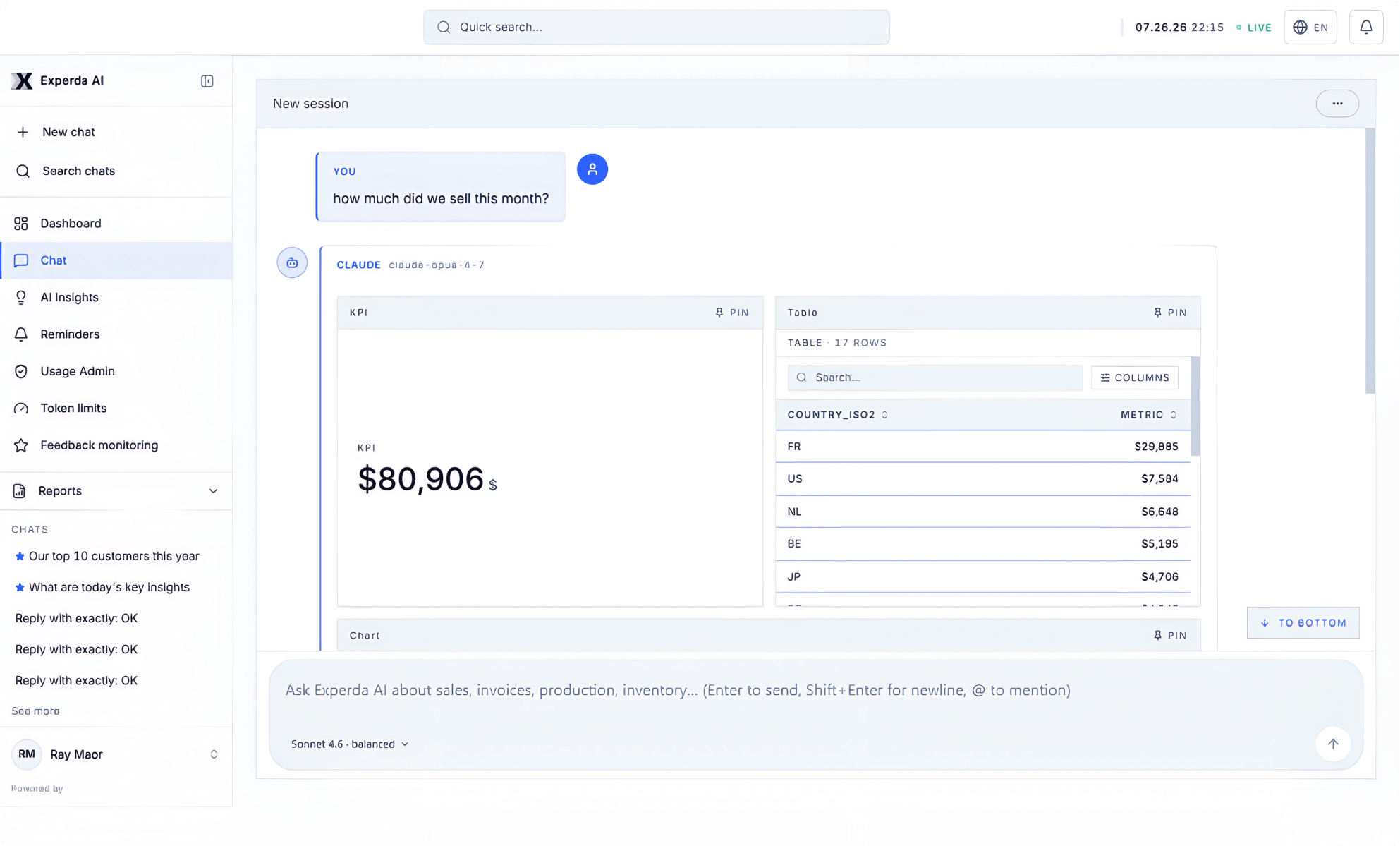
The question is the interface. A regional manager asks in their own words, gets the number and the chart in seconds, and can see exactly which query produced it — without learning SQL and without opening a ticket.
Your data never leaves.
Experda AI is installed inside your perimeter, on your hardware, against your databases.
The model proposes a query; the platform decides whether it may run, under whose permissions, and records the result. Nothing about that decision is delegated to the AI.
Follow the data
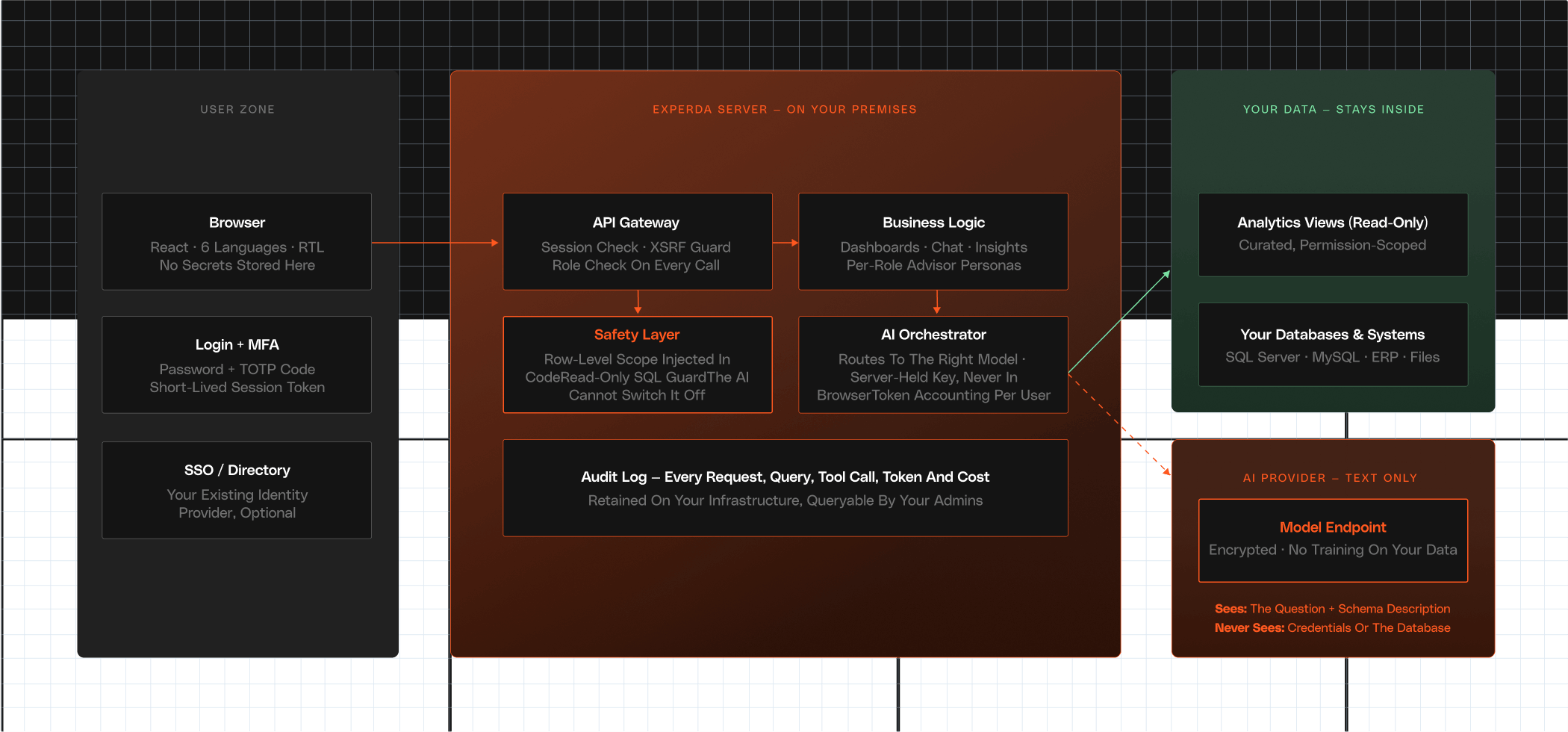
Four zones. The AI provider never talks to your database, and the browser never holds a key.
Never give an AI agent a database login of its own.
Even a “read-only” agent with an unscoped connection can read every row of every customer, for every user who asks.
How Experda AI avoids it
The user’s identity and data scope are attached to the request by the platform, in code, before the model is ever called. The model can compose a query; it cannot choose whose data that query runs against, and it cannot widen its own scope by asking.
Row-level scope is injected server-side, not passed as a hint to the model
A guard rejects INSERT / UPDATE / DELETE / DROP / ALTER outright
Result-size and runtime caps stop a runaway query from loading the estate
Queries hit curated analytics views, not raw operational tables
What an admin can see afterwards
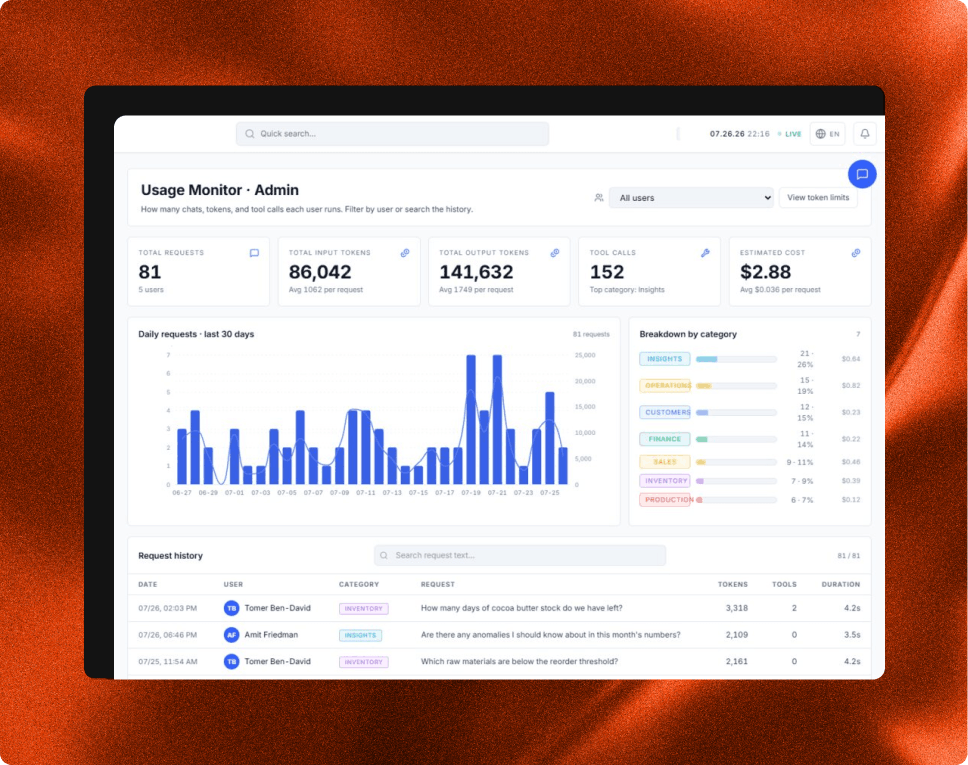
Every answer leaves a record: who asked, in which category, which tools ran, how long they took, how many tokens they cost. Nothing is aggregated away.
What it does out of the box
Six working surfaces, not a chat box bolted onto a database.
Conversational analytics
Plain-language questions become validated read-only queries. Answers come back as prose plus the KPI tiles, tables and charts that support them.
Proactive AI Insights
The engine scans continuously and raises anomalies, risks, trends and opportunities — ranked by severity, before anyone thinks to ask.
Live dashboards
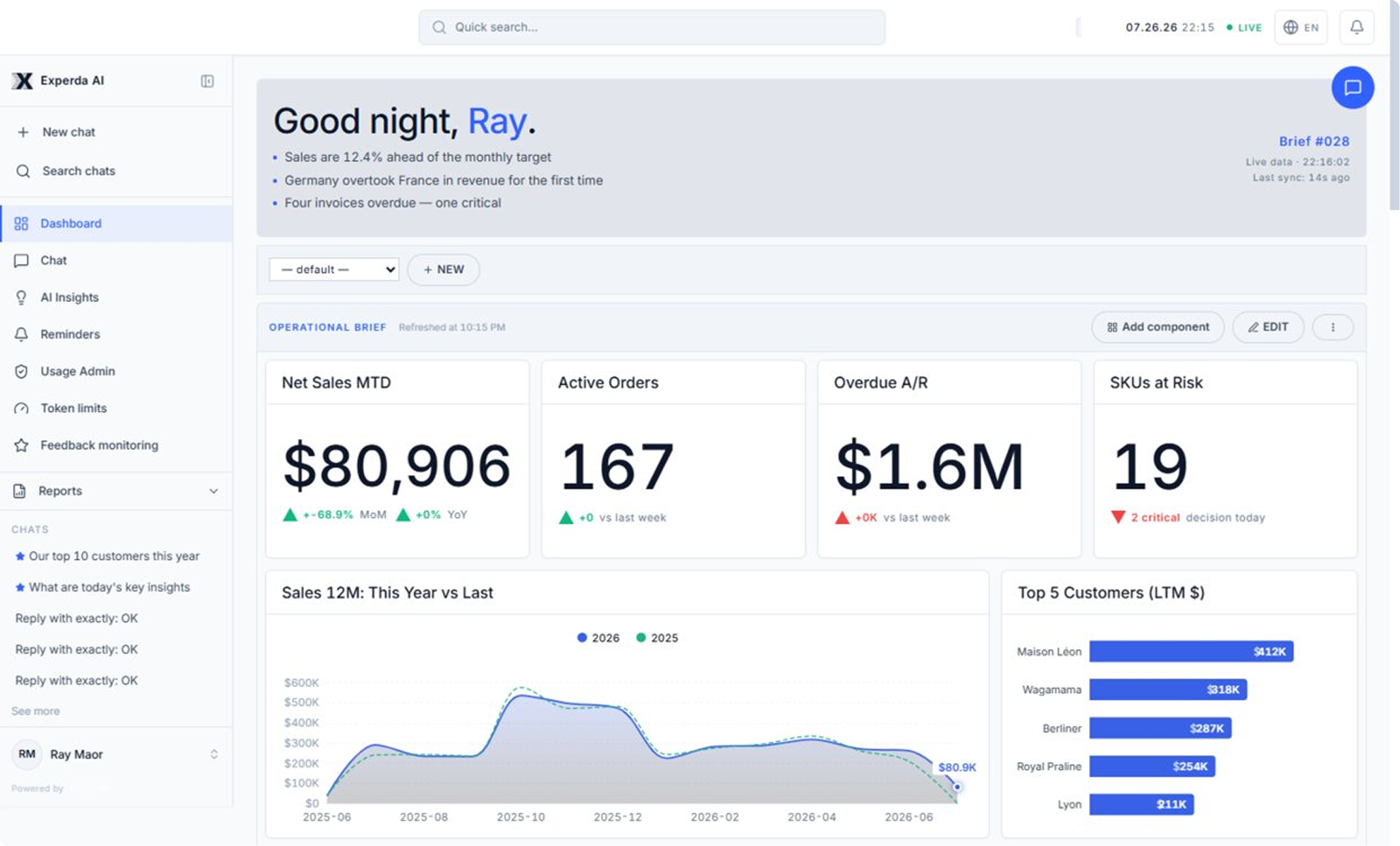
Pin any answer straight from the chat to a personal or shared dashboard. It keeps refreshing against the source on its own schedule.
Reminders & follow-ups
Insights become dated actions — an overdue invoice, a reorder cycle, a certificate expiry — with completion tracking and recurrence.
Governance & audit
Every request, tool call, token and cost is logged per user. Admins set usage caps and review the full history at any time.
Six languages, RTL-native
English, Hebrew, Spanish, French, German and Italian — including proper right-to-left layout, not a mirrored afterthought.
Answers you didn't think to ask for
The insights engine works the estate on a schedule. It surfaces what deviated, what is at risk and what is worth chasing — each one classified, prioritised, and traceable to the query that produced it.
Severity-ranked —
Critical, high, medium, low, with a live count of what is open
Four categories —
Anomaly, trend, opportunity, risk
Role perspectives —
The same estate viewed as a Finance, Sales or Production advisor
Actionable —
Open it in chat to dig in, turn it into a reminder, or dismiss it
A morning briefing that writes itself
Every user lands on their own board: the headline KPIs, what moved, what is overdue, and what needs a decision today.
Software and the people who keep it right
An AI system is not a filing cabinet. Models change, schemas drift, questions evolve. Experda AI is sold as a platform subscription plus an ongoing assurance service.
LAYER 01
Your project
Cut database administration Data mapping, integrations, permissions, views, business logic and the customisations specific to your estate. Yours, once delivered.
LAYER 02
Platform subscription
The right to run the Experda AI engine, interface and safety layer — including versions, patches and security fixes.
LAYER 03
AI Assurance
Quality testing against a golden dataset, model-drift monitoring, prompt and dictionary tuning, and usage governance.
See Experda AI answer your questions, on your data
A 45-minute session on your estate. We connect a read-only view, ask the ten questions your team asks every week, and you judge the answers.